
The Art of Sake Brewing (vol.8)

Nurturing value, developing talent, and conveying the original landscape of the "brewers’ village"
Yasushi Hosoda, President and CEO, Asahi-Shuzo Co., Ltd.
[Contents]
• The shift to light and dry sake brought a "second founding" to the brewery
• Growing rice with the community and protecting the rural landscape
• Cultivating value; "Kubota" as a movement
• Producing sake of legendary quality with a sufficient quantity
• Developing talent; scientific transmission through data and intuition
• Questioning the fixed notions of "sweet” and “dry"
• “Japanese sake is mysterious”---Spreading its wonder and deliciousness to the world
1985, the year "Kubota" was born, marked a turning point for Asahi-Shuzo. It was a time that could be described as a "second founding" for them. Since then, the company has built brand value, nurtured talent, and preserved the natural environment that is the source of sake brewing. Through these efforts over more than 40 years, the community surrounding "Kubota" has grown. Asahi-Shuzo has developed the people and techniques involved in sake brewing and has passed down the original landscape of the "brewers’ village".

The shift to light and dry sake brought a "second founding" to the brewery
The Koshiji Town of Nagaoka City, Niigata Prefecture, is one of Japan's leading heavy snowfall areas. “Kubota,” the fine sake that brought the trend of light and dry sake to Japanese cuisine, was born in this place in 1985. The sixth president, Yasushi Hosoda, says, "There is no doubt that the birth of 'Kubota' was a 'second founding' for our company."
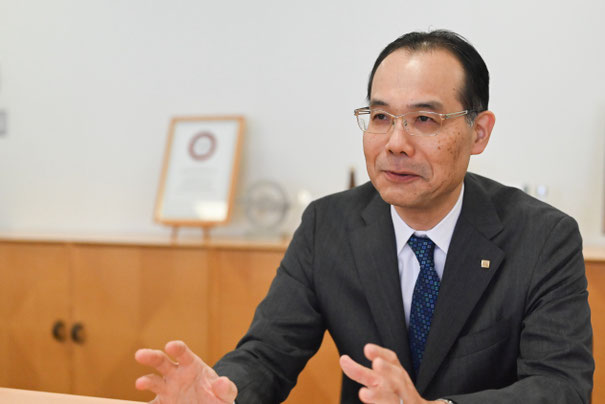
The sixth president, Yasushi Hosoda
Teiji Shima, the “father” of “Kubota,” had transitioned from director of the Niigata Prefectural Brewing Experiment Station to the factory manager at Asahi-Shuzo at the strong request of the fourth president, Toru Hirasawa. Shima was not only an excellent engineer, but also possessed the observational and insightful skills of a marketer.
According to Hosoda, "The social structure was changing from manual labor to desk work, and people's preference to tastes were also changing. While searching for 'drinkability' that suited the times, Mr. Shima decided to propose a crisp, light, and dry sake."
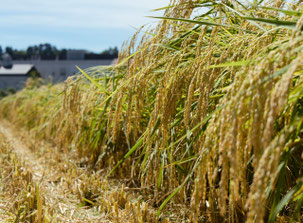
Currently, Niigata Prefecture is known as a "region for light and dry sake," but in the past, like other famous sake-producing regions, it was striving to produce "rich sake."
"A paradigm shift has occurred in Niigata's rice and water, which were previously considered unsuitable for sake brewing. For light and dry sake, soft water with low mineral content is ideal. We use these ingredients to allow for slow fermentation. The disadvantages have now become an advantage," says Hosoda.
Thus, rice grown in Niigata has become an indispensable ingredient for the newly created brand "Kubota." The importance of building relationships with local rice farmers has also increased. Based on the belief that "sake brewing starts with rice production," the company established Asahi Nouken Co., Ltd., which runs agricultural studies and research, in December 1990. Since then, in cooperation with contract farmers, they have been working to cultivate sake-brewing rice varieties such as "Gohyakumangoku," "Takane Nishiki," and "Koshi Tanrei."
Growing rice with the community and protecting the rural landscape
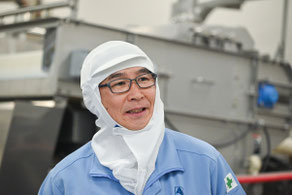
Motoyoshi Yamaga, the Master Brewer of Asahi-Kura
Asahi Kura's master brewer, Motoyoshi Yamaga, says, "We are conducting research and guidance sessions on reduced-fertilizer cultivation, primarily through Asahi Nouken." He himself is also a contract farmer. "If you apply too much fertilizer, the yield may increase, but the quality of the rice will decline.
This will affect the quality of sake. As a contract farmer, I am also studying the amount and timing of fertilization." The relationship between Asahi Nouken and its contract farmers involves the sharing of knowledge that goes beyond the procurement of raw rice. The collaborative relationship has been thriving for over 30 years.
Hosoda emphasizes, "Our business cannot exist without the cooperation of the local community and the natural environment."
The year after the launch of "Kubota," the "Koshiji Town Firefly Association" was established as part of nature conservation activities. Its secretariat is located within Asahi-Shuzo's premises. For many years, the company has worked hand-in-hand with local residents to preserve waterways and cultivate freshwater snails for fireflies.

Firefly associations for schools have also been established in Koshiji Town. In order to preserve the rural landscape for future generations, Asahi-Shuzo has been providing guidance on larval rearing at elementary and junior high schools and distributing maple saplings to new students at Koshiji Junior High School.
"Maple trees can be seen throughout Japan. Early childhood experiences leave a lasting impression, so we hope that even after children grow up and leave the town, seeing maple trees will remind them of their hometown and inspire them to protect the landscape of this place," says Hosoda.
Cultivating value; "Kubota" as a movement
At the heart of "Kubota" lies a philosophy and practice of cultivating value.
"My predecessor used to say, 'Alcohol isn't essential for survival. The reason people still buy it is because they recognize some kind of value in it.' If low pricing becomes the sole value, the company becomes unsustainable. We must pursue essential value that will make people choose us without discounts," says Hosoda.
Based on its high quality, "Kubota" has consistently enhanced its value through branding. This branding consists of the brand name embodying the founding spirit, the calligraphy on the washi paper label, and direct contracts with understanding liquor retailers.

"'Kubota' is not just a product; it's a collective term for an activity. It's a movement involving the manufacturer, liquor retailers, restaurants, and drinkers," says Hosoda.
"Kubota" is not simply sold as a product. Asahi-Shuzo's sales representatives have suggested to liquor stores, "Let's create a community space in a corner of the store," or have encouraged restaurants, "Let's increase the number of fans of your store." As they carried out these activities, word of mouth spread, and a "chain of value transmission" was created.
Amidst the “Kubota” movement, Asahi-Shuzo has enjoyed a period of favorable conditions. However, Hosoda's facial expression becomes serious as he states, "As time passes, the way we communicate value and the purpose behind it will inevitably change."
Taking promotional events as an example, he says, “We need to consider whether to broaden our customer base or to further refine it and target a niche market. We now need to re-examine for ourselves how and which aspects of Kubota's value we should communicate. Now is the time to approach 'Kubota' with the same level of passion as 40 years ago and to carefully consider these issues."
Producing sake of legendary quality with a sufficient quantity
At the heart of 'Kubota' lies the strong will of the fourth president, Toru Hirasawa, to "create a sake of a quality that rivals even the legendary sake." In response, Factory Manager, Shima not only produced this renowned sake but also continuously tackled another challenge: "producing a sake of a quality surpassing the legendary, but in a quantity that wouldn't make it a legend."
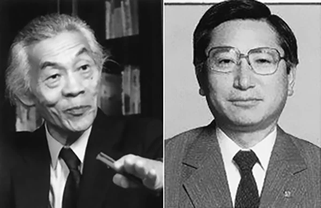
Teiji Shima (left)
and Toru Hirasawa (right)
Hosoda rephrases this as "creating a sake that doesn't distance itself from the average customer." In other words, balancing quality, quantity, and price. This commitment to uncompromising sake brewing while maintaining an accessible price range forms the foundation of the brand.
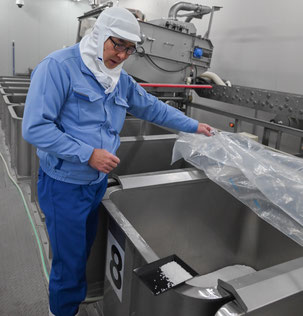
Combining the production volume of "Asahi-kura" and "Shōrai-kura," Asahi-Shuzo produces approximately 4,800 kl of sake annually.
Completed in April 1995, "Asahi-kura" is a facility that embodies the philosophy described above. It is where flagship products, including "Kubota -Manju-," are manufactured. Fujiwara Techno-Art Co., Ltd (FTA) is responsible for the manufacturing, installation, and maintenance of the facility's raw material processing equipment, such as rice washing and soaking equipment, steamed rice cooling equipment, and pneumatic conveying equipment. In addition, the "Ginjo Koshiki," one of FTA’s Ginjo-kura series, is installed there to produce sake for competitions and ultra-premium sake.
Located on the top floor of the four-story facility, the rice washing and soaking room houses a row of 16 soaking tanks.
"By increasing the number of tanks and reducing the capacity of each tank, we minimize uneven soaking. We also increase the washing speed, processing one bale (60 kg) of raw rice in about 15 seconds. To achieve the quality of light and dry sake, we wash and drain the rice very quickly. We use a limited water absorption method. Sometimes the soaking time is less than 10 minutes," says Yamaga.
Even highly polished rice with a polishing ratio of 28% is processed using this equipment.
"This equipment has high overall control precision, so it is easy to make minor adjustments. For example, even if there is a little too much moisture during the soaking process, we can adjust it by removing the moisture during the steaming and cooling process," says Yamaga.
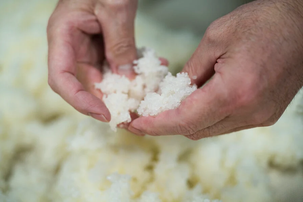
The maximum processing capacity of the steaming and cooling equipment is 1.2 tons per hour. The rice, placed on a conveyor belt, is steamed for approximately 45 minutes before being cooled in a continuous cooling machine. A partition wall separates the steaming machine from the cooling machine, preventing the mixing of hot and cold air. This ensures consistent quality control in this facility.
Developing talent; scientific transmission through data and intuition

While striving to balance quality, quantity, and price through the advancement of its equipment, Asahi-Shuzo places great importance on human resource development and the transmission of skills.
To prevent the dissipation of skills and ensure systematic transmission, they began using year-round employees for sake brewing in 1992. In 1997, it introduced "educational brewing," where young employees learn on the job. Currently, all employees attend the "Asahi University Sake Brewing School," aiming to obtain Level 2 Sake Brewing Technician certification. Furthermore, the company continuously dispatches technicians to the "Niigata Sake Brewing School," jointly established by the Niigata Sake Brewers Association, the Niigata Prefectural Sake Brewers Cooperative, and the Niigata Prefectural Brewing Testing Laboratory. This school serves as a place for technical refinement and networking.
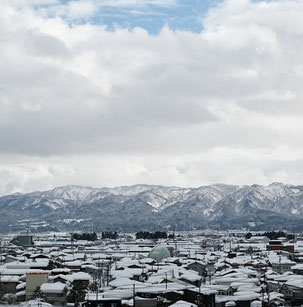
Notably, Asahi-Shuzo has accumulated data on raw material processing and fermentation progress for over 20 years.
"To ensure stable and further improve quality, we acquire and database data from infrared moisture meters and thermometers," says Yamaga.
On the other hand, sake brewing cannot be described solely by numbers. The properties of ingredients change from year to year as the climate differs.
"A master brewer with 40 years of experience once told me, 'You can only encounter the rice of a particular year in that year.' The variables in rice are that significant. That's why we've focused on acquiring rice data from the very beginning," says Hosoda.
Given the interplay of countless variables, the final quality is determined by a fusion of numbers and intuition. As Yamaga explains, "As you can see, this area is a heavy snowfall region, and farmers used to go away for work during wintertime. Many people worked as master brewers in famous sake-producing regions throughout Japan, and their skills are highly developed." Koshiji Town has long been known as a "village of master brewers." In this town, advanced techniques backed by intuition and experience have been passed down through generations.
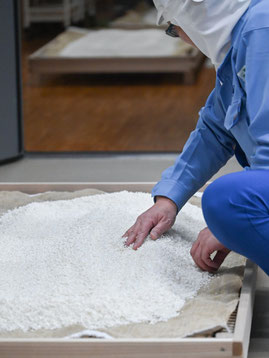
Asahi-Shuzo practices "scientific transmission," utilizing both intuitive skills and data to convey the techniques of master brewers of Koshiji.
"Numbers are useful for objectively conveying feelings. But ultimately, to make good sake, you need to be able to sense the temperature, hardness, and softness of the ingredients the moment you touch them. Steamed rice cools down quickly while you're measuring its temperature, and the same goes for the moisture content," says Yamaga. On-site, he directly touches the steamed rice and koji, honing his senses, comparing them with measurement data, and deriving the optimal solution.
"Sake brewing is something you can't understand in just one or two years. It's so profound that you can't understand everything even after 10 years. When I was young, I learned to sense things by being scolded, 'This is a rice ball. That's not koji,'" Yamaga recalls. Now he's on the side of teaching the next generation. "It's really rewarding when they learn to sense things by touch, or when they realize how delicious the finished sake is," he smiles.
Questioning the fixed notions of “sweet" and “dry"

The elegantly dry and crisp sake, "Kubota," has been loved from the end of the Showa era through the Heisei era and into the current Reiwa era. Over time, people's lifestyles and tastes are constantly changing. In the Reiwa era, it has become inevitable to redefine "dry and crisp" itself.
Hosoda explains, "Distinguishing between what should be preserved and what should be changed is crucial. Simply mimicking the past won't change anything. On the other hand, destroying the previous definition would also be wrong. We needed to thoroughly consider what the true essence of 'Kubota' is."
After approximately three years of discussion, the conclusion they’ve reached was not to “change" but to "expand."
"When we carefully observed the lifestyles of the younger generation and how they access information, we felt that the concepts of 'sweet/dry' and 'easy to drink,' which the sake industry has traditionally recognized, were no longer applicable," says Hosoda.
Then, what is the essence of “Kubota”?
"It is a refreshing and easy-to-drink sake with a clean finish. It disappears smoothly down the throat after swallowing, making it an excellent sake to pair with food. As long as it possesses these features, the essence of 'Kubota' would not be lost even if it had sweetness or a fragrant aroma," says Hosoda. Based on this conviction, they steered towards expanding the variety of “Kubota”.
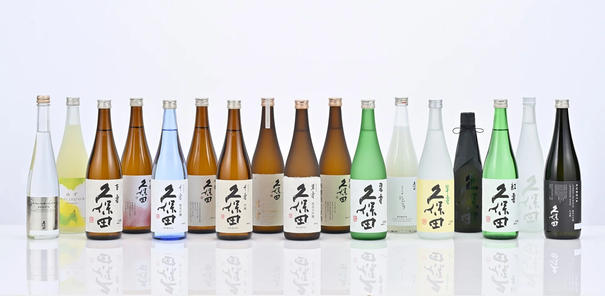
For instance, in addition to the basic "Kubota-Senju-," they developed "Senju-Junmai Ginjo-," "Senju -Ginjo Nama Genshu-," and "Senju -Akiagari-," expressing the differences in taste over time. The fragrant "Kubota -Junmai Daiginjo-" became a hit product within a few years of its release, following "Kubota -Manju-" and "Kubota -Senju-."
They also revisited sparkling sake, a project they had abandoned since their 1968 attempt. "Kubota -Sparkling-" offers a suitable option for pairing with Western cuisine and is popular in the restaurant market. It is gaining prominence along with new flavors such as "Kubota -Junmai Ginjo Nigori-".
“Japanese sake is mysterious”---spreading its wonder and deliciousness to the world
Asahi-Shuzo has nurtured natural environment necessary for growing raw materials, refined brewing techniques, and developed people’s skills in collaboration with the local community. At the same time, it has communicated the value of "Kubota" to the market. Their continuous efforts have elevated "Kubota" from a mere product to a movement, maintaining its popularity for over 40 years.
"We envision a world where each customer has their own story of 'Kubota'," says Hosoda. "Even within Japan, many people associate 'wine' with delicious alcoholic beverages. However, if drinking 'Kubota' can inspire people to think of 'sake' as a delicious drink, it might change the future of Japanese sake overall."
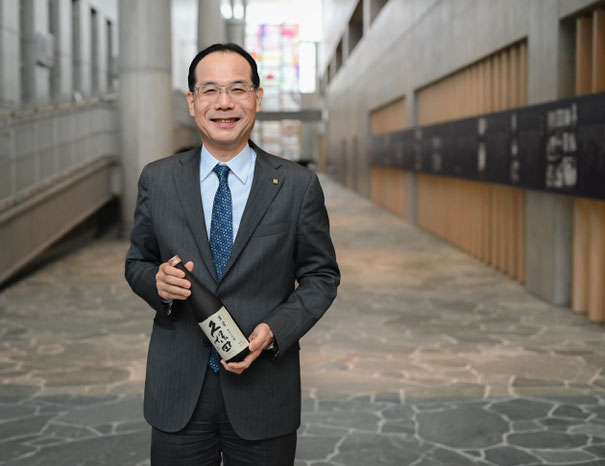
Currently, Asahi-Shuzo exports to 38 countries. They are actively pursuing overseas promotion in cooperation with local companies. Hosoda believes that "instead of simply applying Japanese domestic communication to overseas markets, we should adapt our expressions to local customs and sensibilities." He describes sake as "a mysterious drink." He is willing to engage in thorough discussions to spread the wonder and deliciousness of sake to the world.
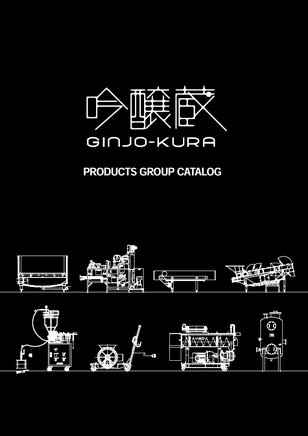
Catalog
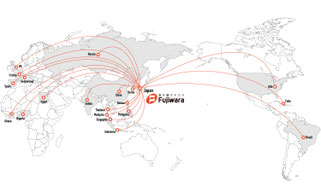
Fujiwara Techno-Art develops machinery and plants for about 27 countries around the world, and exports comprehensive technologies including design, manufacturing, installation, and follow-up services. Some of the products introduced in this article have also been exported overseas.
Contact Us
フォームが表示されるまでしばらくお待ち下さい。
恐れ入りますが、しばらくお待ちいただいてもフォームが表示されない場合は、こちらまでお問い合わせください。